Hamas Disarmament Plan: Promising Path Despite Significant Challenges in Gaza
Explore how a Hamas disarmament initiative presents unprecedented opportunities for Gaza's future while facing substantial political and military obstacles.
Hamas Disarmament Initiative: A Complex Path Forward
A Hamas disarmament plan has emerged as a potentially transformative proposal for Gaza's future, offering a glimmer of optimism amid decades of conflict and devastation. Despite the ambitious nature of this Hamas disarmament plan, multiple formidable obstacles threaten to undermine its successful implementation, requiring unprecedented cooperation across fractured political landscapes.
The proposal represents one of the most significant attempts to address the underlying militarization that has perpetuated cycles of violence throughout the region. However, the intricate dynamics of contemporary Middle Eastern politics, combined with the legacy of warfare and deep-seated mistrust, create substantial complications that cannot be easily overcome.
The Political Reality: Trust Deficits and Historical Grievances
The political dimension of implementing a disarmament framework extends far beyond technical negotiations. Multiple stakeholders—including various Palestinian factions, Israeli government bodies, international mediators, and regional powers—each bring competing interests and historical grievances to the negotiating table. The erosion of trust accumulated over generations presents perhaps the most formidable challenge to achieving consensus on disarmament mechanisms.
Previous diplomatic attempts have repeatedly faltered when confronted with the reality that all parties harbor legitimate security concerns rooted in documented violence and betrayals. The prospect of unilateral disarmament triggers existential fears among security-conscious leadership, making incremental, verifiable approaches essential to building confidence.
War's Devastating Toll: A Generation Shaped by Conflict
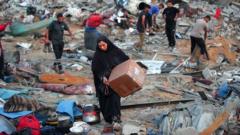
The humanitarian consequences of prolonged warfare cannot be divorced from disarmament negotiations. The deaths of thousands of civilians have left profound scars on the Palestinian population, particularly among younger generations who have known nothing but conflict. This collective trauma informs public opinion and shapes political leadership's negotiating positions, as leaders must maintain legitimacy with populations scarred by loss.
The destruction across Gaza has eliminated critical infrastructure, displaced communities, and created economic desperation that complicates peace-building efforts. Reconstruction needs are immense, and any disarmament agreement must simultaneously address economic revitalization to prevent the security vacuum that could fuel renewed extremism.
Zero-Sum Perception and Security Dilemmas
A persistent challenge stems from the zero-sum mentality that characterizes current regional dynamics. Many stakeholders perceive security gains for one party as automatic losses for another. This security dilemma creates a prisoner's-dilemma scenario where individual actors, acting rationally in their own perceived interests, collectively produce suboptimal outcomes for all parties.
Breaking this psychological framework requires institutional mechanisms that provide transparency, verification, and graduated reciprocal steps. International oversight and guarantees become essential components of any credible disarmament architecture, though questions about neutrality and enforcement capacity remain contested.
International Dimensions and Regional Interests
The involvement of regional and international powers adds layers of complexity beyond direct Palestinian-Israeli dynamics. Various state actors maintain strategic interests in Gaza's political configuration and are unlikely to sacrifice perceived advantages for abstract peace principles. Coordinating multiple external stakeholders whose interests may diverge significantly presents diplomatic challenges of extraordinary magnitude.
A Fragile Foundation for Hope
Despite these formidable obstacles, the emergence of a disarmament proposal signals that some parties recognize the unsustainability of perpetual conflict. The proposal's existence itself represents acknowledgment that current trajectories benefit no one and that alternative frameworks, however difficult to implement, warrant serious consideration.
The success of a Hamas disarmament plan will ultimately depend upon whether stakeholders can prioritize long-term peace dividends over short-term tactical advantages. This requires leadership capable of articulating compelling visions of post-conflict prosperity and security arrangements that credibly address legitimate concerns across all communities affected by decades of violence and displacement.